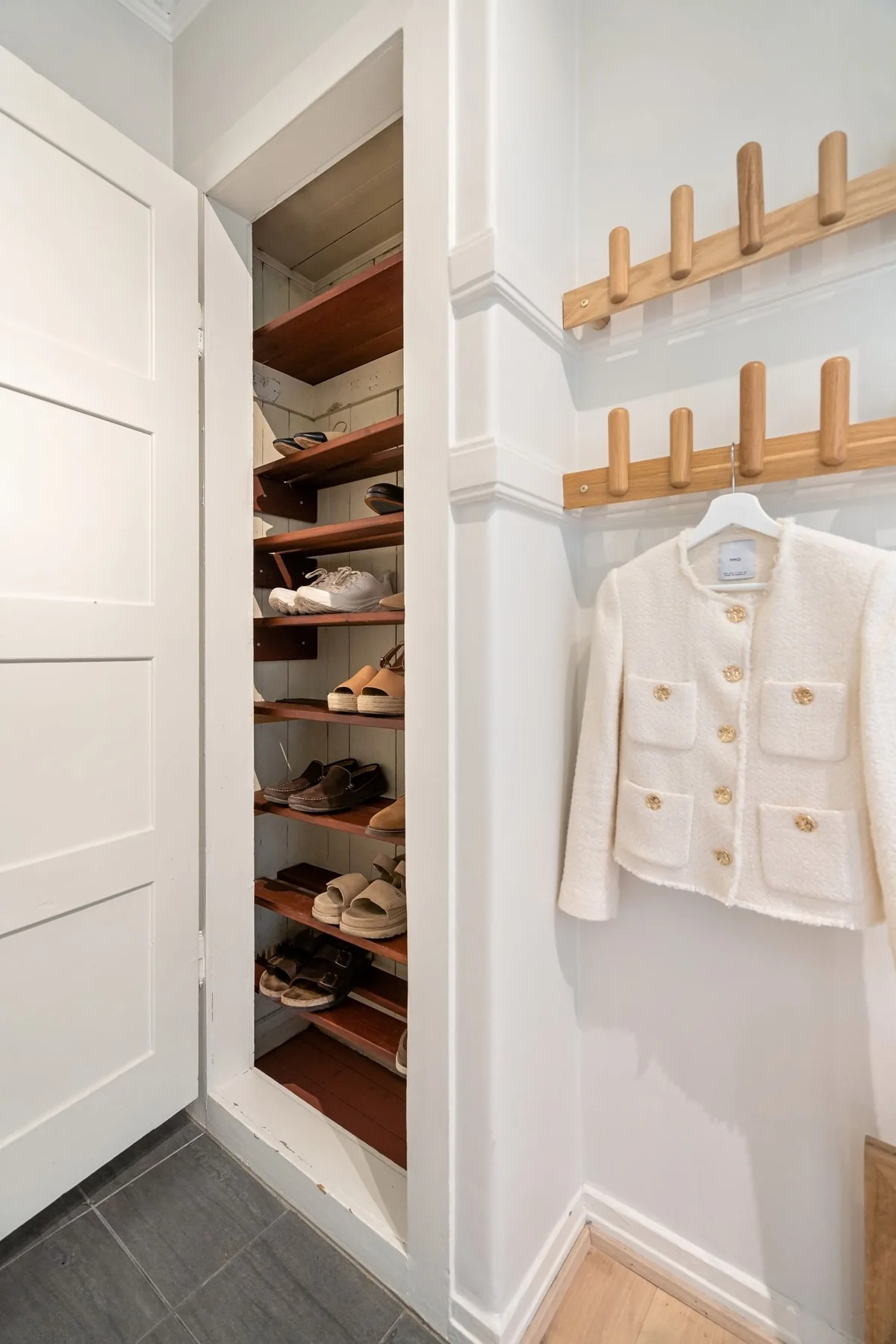
A hanger suspended from a wall hook can create a temporary place for a garment outside the main wardrobe. Check the complete arrangement before making it part of daily dressing. The hook, hanger and clothing have separate requirements, and a neat photograph does not establish that every combination is appropriate.
Begin with the installed fitting
Read the hook's mounting, load and intended-use information. If the installation is uncertain, resolve that through appropriate help before relying on it. An available-looking wall position is not evidence that a fitting can support whatever happens to fit over it.
Keep the door's intended movement and required access clear. Do not alter a hinge or other fitting to accommodate clothing. The storage idea needs to work within the room's actual constraints rather than make ordinary movement depend on removing a garment first.
Choose appropriate garment support
Follow the clothing's own care and storage guidance. Where hanging is appropriate, use a hanger suited to the actual garment rather than whichever spare item sits most neatly on the hook. Similar outline does not establish identical support.
Check the hanger's condition and intended operation. Avoid improvised attachments that could affect either the fitting or the garment. A temporary return place should still be a considered arrangement, not a reason to overlook the product information used elsewhere in the wardrobe.
Include the full clothing shape
Look at sleeves, hem and associated parts as well as the area resting on the hanger. The garment can occupy more space than the fitting suggests. Keep it clear of unsuitable surfaces and other belongings according to its needs.
Do not compress several garments onto the same arrangement merely because the first one looked compact. Each additional piece changes the occupied space and load. Review the actual guidance and room use before expanding the role.
Define the temporary purpose
Decide whether the position holds tomorrow's selected layer or another clearly understood group. Keep garments awaiting care distinct from pieces ready for use. A visible hanger does not automatically communicate the clothing's status to other people sharing the space.
Give the arrangement a clear return step if it is only temporary. Clothing should not remain there indefinitely because its main storage position has been filled with unrelated belongings. Preserve an appropriate place in the wardrobe for the garment's ordinary return.
Test an ordinary departure
Remove and replace the garment carefully through its intended movement. Notice whether the hanger catches or disturbs nearby objects. If the arrangement repeatedly requires another person to hold the door or clear a passage, choose a more suitable position.
Review the setup when the garment or seasonal contents change. A useful wall-hook hanger arrangement supports a specific clothing task while respecting the room and products involved. It remains practical because its whole occupied shape and intended purpose are understood, not simply because a hanger can be balanced on a visible hook.
Related reading
Working Space between Hanging Clothes, Organise Your Wardrobe Before Buying Another Storage System.
Our approach
Start with what you own, identify a real gap, then compare fit, materials, care and return terms before buying. Availability and prices can change. Read our editorial policy or send a correction.