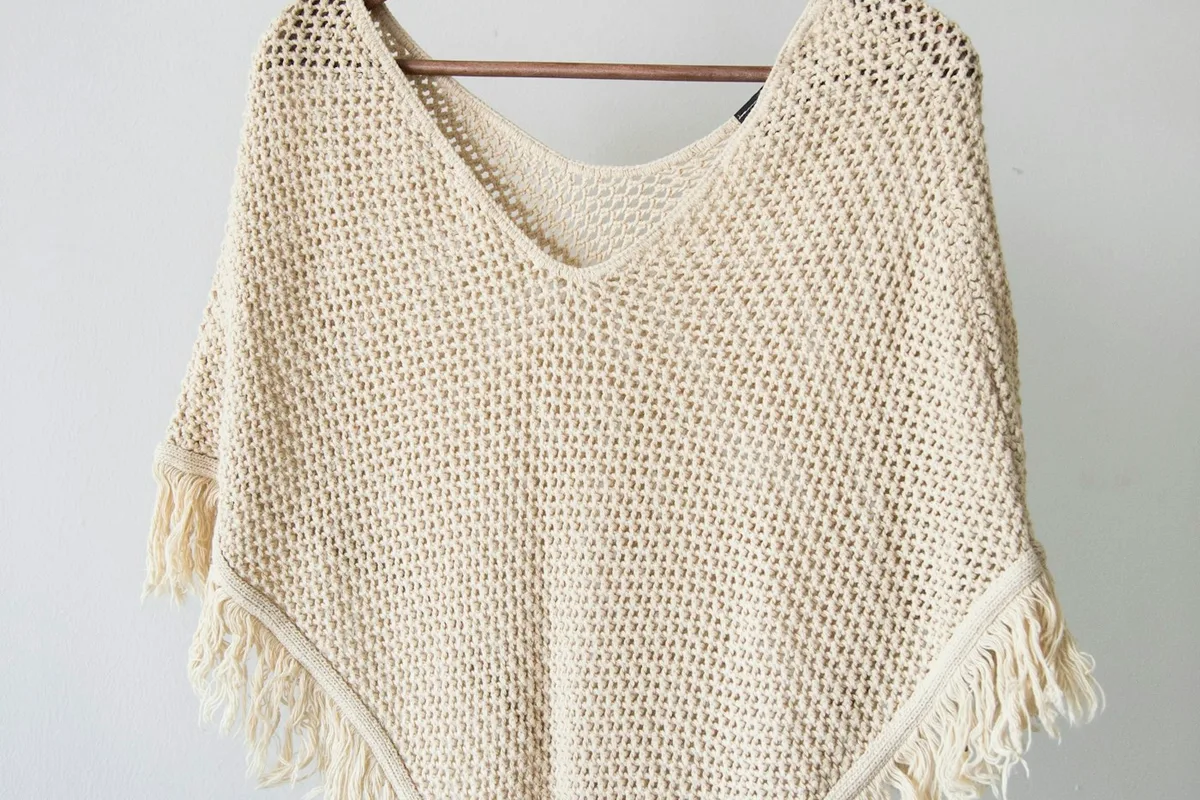
An open-textured knit makes two garments visible at once. Its yarn supplies one shape, while the base appears through repeated gaps and around the neckline. Decide how much contrast you want rather than assuming the underlayer should disappear. A related colour can quiet the pattern; a darker or otherwise distinct one can make it deliberate. Begin with actual suitable tops already owned before choosing another purchase.
Separate colour from shape
Choose two familiar base options and note where their shapes differ. A high neckline and a broader opening change more than colour. The comparison can still be useful when those differences are named instead of quietly attributed to the tone alone.
Keep the lower garment, footwear and knit's ordinary arrangement steady. This makes the visible base the main question. A temporary fold held for the camera can alter the amount exposed without giving the outfit a repeatable form.
Look at a quieter version first
Try a base whose tone is relatively close to the knit. The repeated openings may become less distinct from a normal distance, while the yarn still supplies visible texture. That can be an intentional preference rather than a compromise.
Read the neckline and any lower base hem as well. Their edges can remain clear even when the colours are similar. There is no requirement to conceal every sign that the outfit contains a second garment.
Compare the stronger contrast
Change to another suitable owned top and let the pieces settle normally. A darker base beneath pale yarn can emphasize the open pattern across the torso. The contrast is a visible option, not automatically evidence that the wrong layer is showing.
Use ordinary available light and keep product facts separate. A photograph of a fringed pale knit cannot establish age, fiber or care for another item. The real garment's information remains relevant even when the colour relationship is appealing.
Include the day’s ordinary movements
Sit, stand and move appropriately, then review without restoring each fold. The amount of base at the shoulder or lower edge may change. An arrangement requiring repeated attention is a different practical choice from one that remains settled.
Keep the base outfit understood if the knit comes off. The top and lower garment should retain their own role rather than function only as a background selected for the outer pattern. This matters when the knit is an optional layer used during only part of the day.
Begin without another necklace or scarf so the two fabric areas remain clear. An accessory can be compared later for a defined preference. Save the actual garment identities with one reason for each useful version. A close-toned base and a contrasting one can both belong to the wardrobe, leaving another underlayer as a separate choice rather than the assumed answer to every visible gap.
Related reading
Black Clothes with More Than One Texture, A Soft Cardigan over a Rounded-Neck Base.
Our approach
Start with what you own, identify a real gap, then compare fit, materials, care and return terms before buying. Availability and prices can change. Read our editorial policy or send a correction.