The zip closes, but the item you need has disappeared beneath three nearly identical lip products. A useful makeup bag solves that small everyday annoyance. It does not need to hold a complete dressing table. For a commute, a weekend away or a change from work to dinner, it needs to keep the right few things visible, closed and easy to reach without emptying everything onto a public counter.
Separate the home routine from the travelling routine
Empty your current bag onto a clean surface and divide the contents by actual use. Put the things you apply at home in one group, things you genuinely reapply away from home in another, and unused duplicates in a third. Check product labels and condition as you sort. Follow the manufacturer's storage and replacement guidance rather than keeping old cosmetics simply because the container is not empty.
A desk-day kit might contain one chosen lip product, a mirror and whichever small item your own routine regularly calls for. A weekend kit has a different job: it needs the products required to start the day as well as refresh it. Do not make the daily bag larger to accommodate a trip you take twice a year. A second pouch you already own can serve the occasional extra load.
Choose construction around the contents
| Bag style | Useful for | Check before buying |
|---|---|---|
| Flat pouch | A few slim daily items | Whether bulky caps distort the zip |
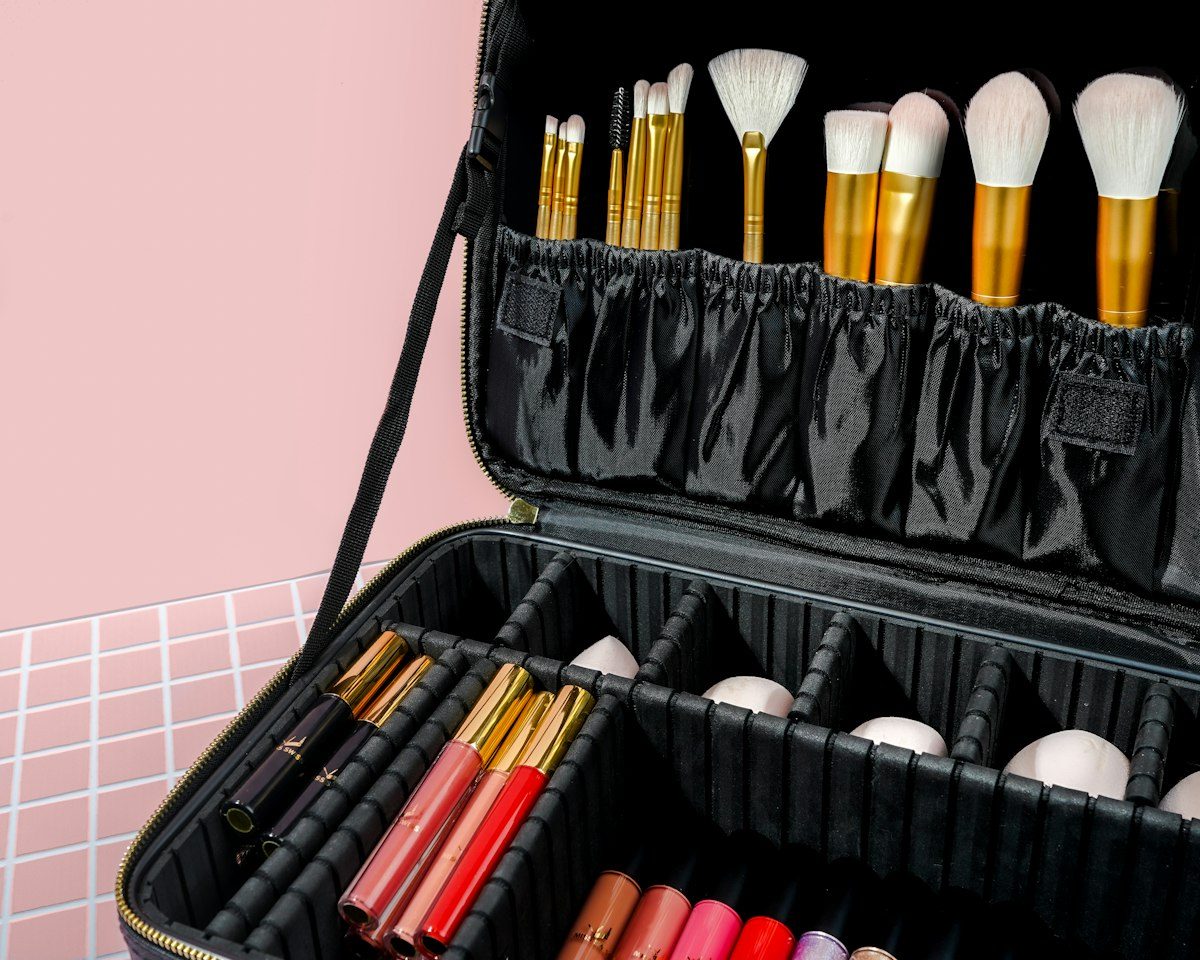
| Box-shaped case | Standing bottles and weekend essentials | Actual interior height and handle space |
| Divided organiser | Separating tools and colour products | Whether fixed sections fit your items |
Measure the longest brush and tallest closed bottle you intend to carry. Exterior measurements are only a guide; thick padding and rounded corners reduce usable room. Look at how far the zip opens and whether the bag sits steadily when open. A fashionable narrow opening may be less useful than a plain case in which you can immediately see everything.
Make cleaning and closing easy
Choose a lining whose care instructions you can follow. A wipeable appearance is not proof that a material tolerates every cleanser or can go through the washing machine. Powder gathers in seams, so look closely at the corners and pockets in product photographs. If the case has a removable insert, confirm how both the insert and outer case should be cleaned.
Keep caps firmly closed and protect delicate tools from being bent or pressed against loose products. A separate sleeve may be helpful for brushes, provided you follow the tool maker's storage guidance and let washed tools dry before packing them. For travel, check the rules of your transport provider for liquids; a decorative pouch does not automatically meet airport requirements.
Replace a gap, not the entire contents
Once you can see the kit, it becomes easier to shop. Perhaps you need a smaller mirror because the existing one fills half the space. Perhaps you need no new makeup at all, only a case that opens wider. If you do replace a cosmetic, choose a format that suits the job rather than the smallest package available. A miniature can be convenient without being the most economical option per amount.
MUJI's official packing-organiser collection offers a browsing starting point for comparing pouch and travel-storage options. Check the specific dimensions and care details of any item you shortlist; this guide does not claim that every organiser is suitable for cosmetics or liquids.
The five-minute edit
- Remove products you never use away from home.
- Check labels, closures and the condition of containers.
- Measure the items that genuinely need to travel.
- Compare interior access as carefully as colour and pattern.
- Leave some empty room so the zip closes without pressure.
Frequently asked questions
Should every product be travel size?
No. Consider how often you travel, how much you use and the relevant transport rules. A small size is worthwhile when it solves a real space problem, rather than creating another partly used duplicate.
Is a transparent bag always better?
Visibility can help, but check the opening, seams and care instructions too. You may prefer a fabric case with a pale lining if that makes your contents equally easy to find.
What about a bag with lots of compartments?
Compartments are useful when their size matches your possessions. A flexible open pouch may work better if your kit changes regularly. Buy for your actual contents, not the impressive empty photograph.
Our approach
Start with what you own, identify a real gap, then compare fit, materials, care and return terms before buying. Availability and prices can change. Read our editorial policy or send a correction.